Movement guide
Leaning bay window on a period front wall
A bay window pulling away from the front of a Victorian or 1930s house is one of the most common signs of movement in Barnet. Find out why bays sit on shallower footings than the main wall and what a specialist measures before deciding on repair.
Why the bay was built differently from the rest of the house
Victorian, Edwardian and 1930s builders treated the bay as an addition rather than part of the main structure. The front wall of the house usually sits on a continuous strip footing dug to a consistent depth. The bay projects forward and often has its own smaller foundations, sometimes no deeper than a few courses of brickwork below ground level.
This difference matters because shallow footings respond faster to changes in the soil beneath them. London clay shrinks when it dries and swells when it gets wet. A footing set half a metre deep moves sooner and further than one set two metres down. So the main wall holds relatively still while the bay drops or tilts outward.
The join between the two structures is where the stress concentrates. Brickwork that was laid flush against the main wall decades ago begins to separate as the bay settles at its own pace. You see this first as a thin crack running vertically where the bay meets the house, widening slightly each dry summer.
What makes the movement worse over time
Tree roots are the most frequent cause of clay shrinkage under a bay. A mature oak, poplar or willow in a front garden can draw thousands of litres of water from the soil during a dry spell. Because the bay footing is shallow, the drying clay pulls support away from it long before the deeper main wall feels any effect.
Leaking drains compound the problem. Many older houses in Barnet still have original clay drainage pipes running directly past or under the front bay. A fracture in one of these pipes washes fine particles out of the subsoil, leaving a void. Waterlogged clay also loses its bearing capacity, so the footing sinks into softened ground.
Seasonal cycles make the damage cumulative. Each summer the clay shrinks and the bay drops a fraction of a millimetre. Each winter the clay rehydrates and pushes back, but rarely to exactly the same level. Over ten or twenty years these small movements add up until the gap at the join is wide enough to see daylight through.
What a specialist looks at before choosing a repair
A structural engineer or subsidence contractor will not guess what is happening from the pavement. They measure the width and direction of every crack using tell-tales or digital gauges, then leave those monitors in place for several months to record whether the movement is ongoing or happened years ago and stopped.
They dig trial holes beside the bay and beside the main wall to compare foundation depths. Soil samples go to a laboratory to confirm the clay type and its moisture content. Drainage runs are tested with cameras or air pressure to rule out leaks. Nearby trees are mapped by species and distance from the footing.
Only after these readings exist can anyone say whether the bay needs underpinning, resin injection, screw piling or simply the removal of a tree and a period of monitoring. Rushing to pour concrete under a bay that is moving because of a broken drain wastes money and can make the problem harder to fix later.
Repairs used to stabilise a moving bay window
Underpinning extends the existing footing down to stable soil. For a bay, this usually means digging short sections of trench beneath the projecting walls and filling them with concrete in a planned sequence so the structure is never left unsupported. It is effective but disruptive, especially if the bay contains original tiled floors or leaded glass.
Resin injection pumps expanding geopolymer material into the ground beneath the footing. The resin fills voids and compacts loose soil without excavation. It suits situations where access around the bay is tight or where the movement is moderate and the soil conditions allow it.
Screw piling drives steel helical piles past the weak clay into a load-bearing layer. A bracket transfers the weight of the bay onto the pile. This method avoids large excavations and works well where the ground is too soft for traditional mass concrete.
The choice depends entirely on what the site investigation found. A bay moving because of a leaking pipe needs the pipe fixed first; a bay dropping because of a nearby tree may need root management before any ground repair makes sense.
Signs your bay window might be moving
A bay window separates from the main wall when its shallow foundations settle faster than the deeper footings behind it. These are the visible signs that movement may be happening at the front of your home.
- 1
Vertical crack at the join
A line opening where the bay brickwork meets the main front wall. It may widen toward the top and let draughts in.

- 2
Tilted window frames
Timber or uPVC frames that no longer sit square, making sashes stick or leaving uneven gaps around the edges.

- 3
Sloping bay floor
A ball placed on the bay floor rolls toward the outside wall. The slope may be slight but noticeable underfoot.

- 4
Gaps at the skirting board
The skirting inside the bay pulls away from the floor or the wall as the two surfaces move at different rates.

- 5
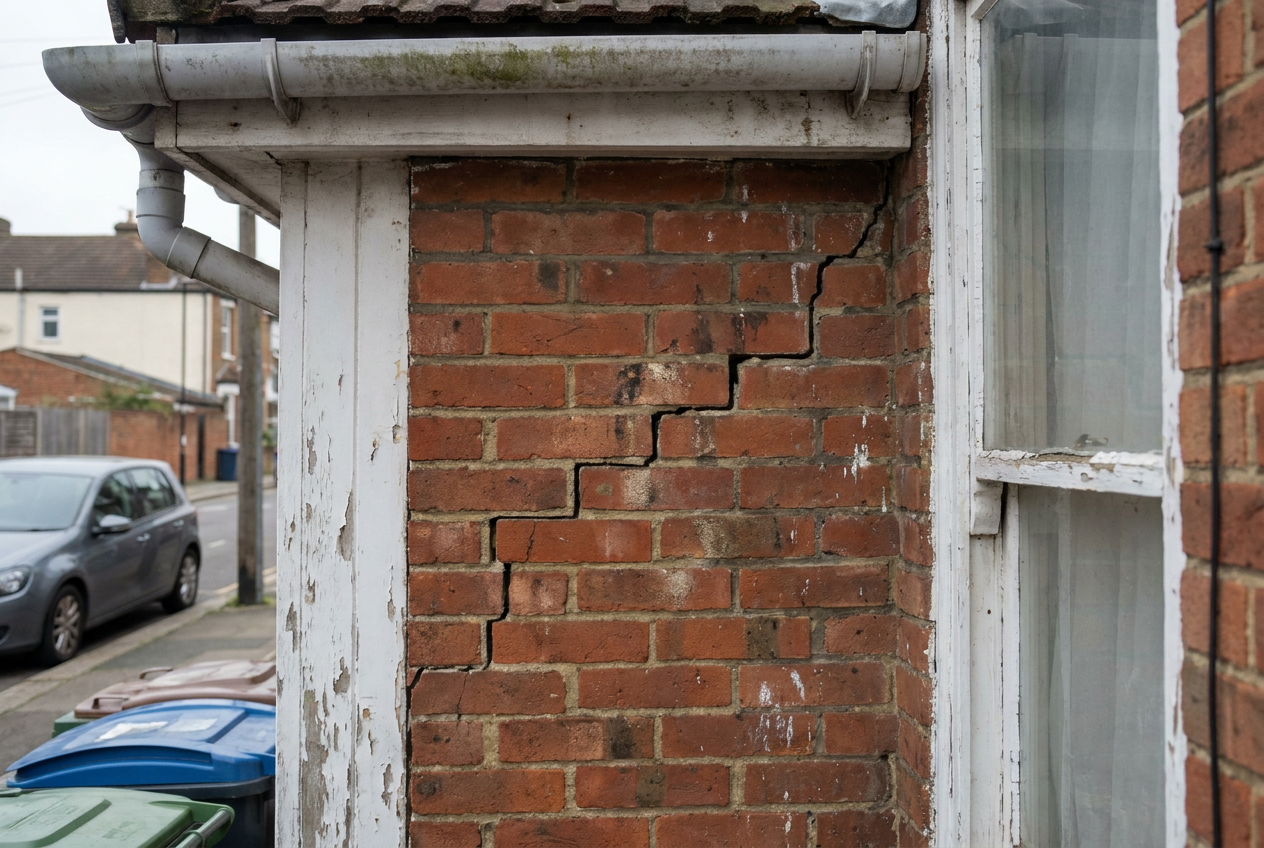
Stepped cracks in exterior brick
Cracks following the mortar joints in a stair pattern across the bay side walls, wider at one end than the other.
Questions about bay window movement
Answers to the things homeowners ask when they notice their bay starting to separate from the house.
- Will it fall off?
- Complete collapse is rare. Bays move slowly over years. But an open joint lets water in, which rots timbers and damages internal plaster.
- Does every bay need underpinning?
- No. If the cause is a leaky drain or a removed tree, fixing that and monitoring the cracks may be enough.
- How long does monitoring take?
- Specialists usually read crack gauges over six to twelve months to see if movement follows seasonal patterns or has stopped.
- Can I sell the house while it moves?
- You must disclose known subsidence. Buyers and lenders typically want a structural report and evidence that repairs are planned or finished.
- Is it covered by insurance?
- Most buildings policies cover subsidence damage, subject to an excess. Your insurer will appoint loss adjusters who instruct the investigation.
Find out what the crack means
Describe what you have noticed at your bay window. A specialist firm will review the details and arrange a site visit if the signs point to ground movement. There is no obligation to proceed with any repair.
- No obligation
- Local specialists
- Free initial review