Monitoring advice
Crack monitoring and why waiting can be right
A crack in your home feels urgent, but a specialist needs to see how it behaves across the seasons first. Find out what monitoring involves, why waiting is necessary and what you should record while the months pass.

Why nobody will commit to a straight repair
You have noticed a crack, or a door that sticks, and you want it fixed. But when a structural engineer visits, they rarely prescribe a repair on the first day. That hesitation is frustrating. It can feel like nobody is taking the problem seriously.
The reason is simple. A single visit shows a snapshot of damage, not its cause or its direction. A crack might be growing, shrinking or staying still. Without knowing which, any repair is a guess. Underpinning a wall that has already stopped moving wastes money. Filling a gap that will widen again next summer achieves nothing.
Specialist firms need evidence before they act. They look for patterns in movement over time. Those patterns only emerge across weeks and months, as the weather changes the moisture beneath the foundations. Rushing into a method like resin injection or screw piling without that data risks making the problem worse. So the first step is almost always observation, not construction.
What a crack gauge actually measures
A crack gauge is a small device fixed across a fracture in brickwork or plaster. The simplest type is two plastic plates that overlap, with a grid printed on one and a crosshair on the other. As the walls move, the crosshair shifts against the grid.
This tells the engineer two things: whether the crack is opening or closing, and whether the two sides are sliding past each other vertically. Both directions matter. A crack that opens horizontally suggests the wall is pulling apart. One where the left side drops below the right points to uneven settlement beneath that corner.
Gauges do not fix anything. They are instruments for gathering numbers. A specialist will read them at intervals, usually every few weeks, and plot the readings on a graph. That graph reveals whether the movement is accelerating, slowing down or reversing with the rain. Only then can they decide if underpinning is needed or if the house is settling back on its own.
Level monitoring and seasonal readings
Crack gauges show local movement at one spot. Level surveys show what the whole building is doing. An engineer takes precise height measurements at several points around the outside walls, using optical equipment accurate to a fraction of a millimetre.
They repeat these measurements every month or two. Over time, the readings build a picture of tilt. Perhaps the south-west corner is sinking relative to the north-east. Perhaps the entire front elevation is dropping evenly, which is less alarming than differential movement.
Season matters because London clay swells when wet and shrinks when dry. A house built on this soil moves with the calendar. Readings taken only in January miss the summer shrinkage entirely. Engineers wait for at least one full wet and dry cycle, roughly twelve months, before they trust the trend. A single dry summer followed by a mild winter might produce no movement at all, so patience is part of the process.
Why the answer needs a full year
Twelve months sounds like a long time to live with a crack you worry about. But the ground beneath a home in Barnet responds slowly to rainfall and drought. Tree roots draw moisture from the soil in summer, causing clay to contract. Winter rains let it swell again.
If a specialist designs a foundation repair based on three months of winter readings, they are working with incomplete information. The repair might be too shallow, or placed on the wrong wall. When summer arrives and the clay shrinks further, the new support could fail.
Waiting through the seasons also separates active subsidence from historic damage. Many older houses cracked decades ago and have been stable since. Monitoring proves whether the movement is current. If the gauges barely shift over a year, the solution might be cosmetic repointing rather than major structural work. That outcome saves thousands of pounds and months of disruption.
What to record yourself while you wait
You do not have to sit idle during the monitoring period. Keep a notebook and note changes you see inside the home. Write down the date a door starts sticking or frees itself. Record whether cracks in plaster appear wider after a dry spell.
Photographs help. Hold a coin or ruler next to a crack when you take the picture so the scale is clear. Date the files. Take them from the same angle each time, standing in the same spot. A series of six photographs over six months tells a specialist far more than a single image taken in panic.
Watch the drains too. If a gully near the house starts holding water, or you smell damp earth indoors, mention it. Leaking pipes wash soil away and accelerate movement. Your observations between professional visits fill gaps in the data and help the engineer build a reliable timeline of what your home is doing.
Signs your home is moving while you wait for answers
Movement leaves marks. Some appear suddenly, others creep over weeks. Spotting them early gives the monitoring specialist better data to work with and helps you track whether the situation is changing.
- 1
Diagonal cracks near windows
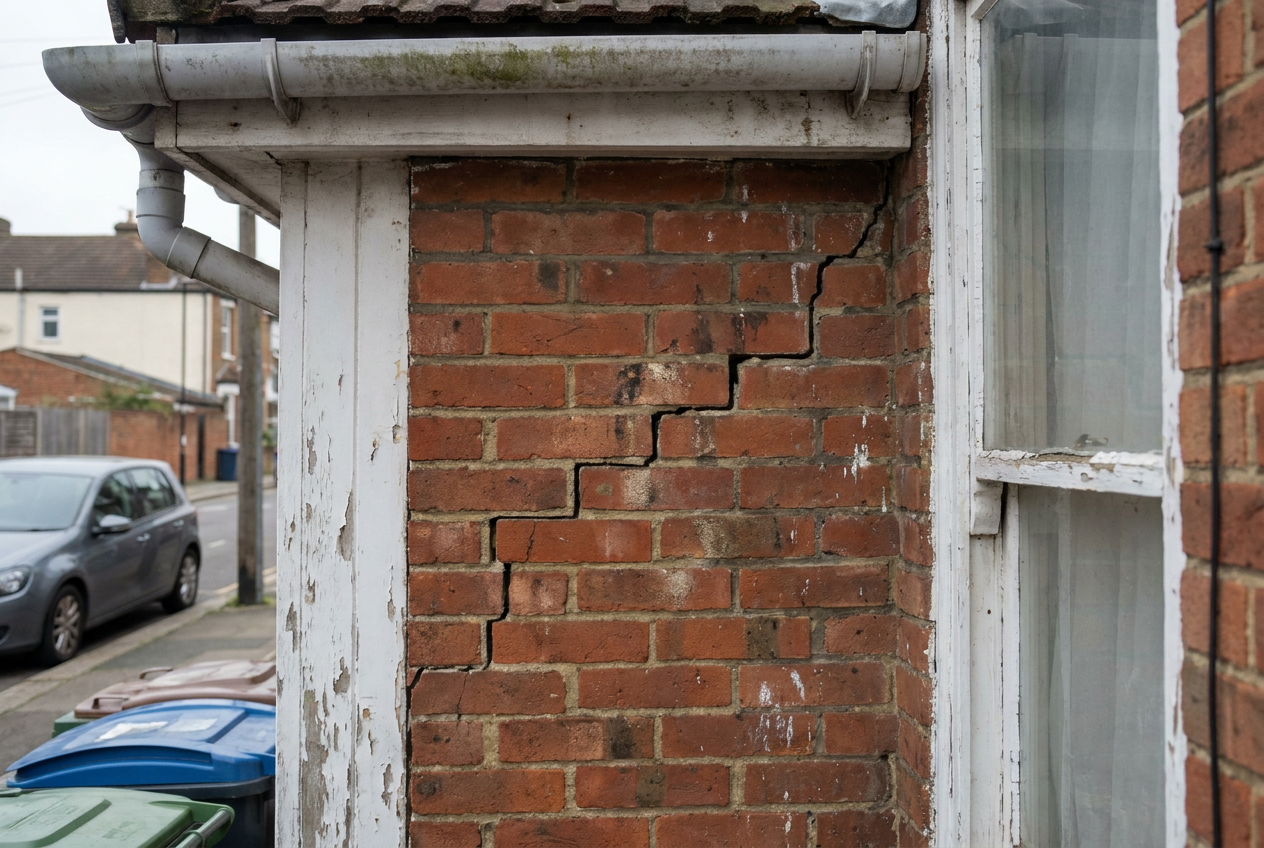
Lines running at an angle from window corners often follow the path of least resistance through brickwork. They may widen slowly over dry months.

- 2
Doors that jam in their frames
A door that swung freely last month but drags now suggests the frame has distorted slightly. Check if it eases again after heavy rain.

- 3
Gaps opening at skirting boards
When a wall tilts even a few millimetres, the skirting pulls away from the floor. The gap might be thin enough to slide paper into.
- 4
Floors that slope visibly
Place a marble on the floor. If it rolls consistently toward one wall, the joists beneath may be following the ground downward.
Questions about monitoring and waiting
Common questions about the delay. For others, read the full list of subsidence questions. Read more questions.
- How long does crack monitoring usually take?
- Most specialists ask for readings across twelve to fourteen months. This covers a full cycle of wet and dry seasons, giving enough data to see whether the movement is ongoing or has stopped.
- Will my insurance cover the monitoring period?
- Buildings insurers typically fund the investigation phase, including gauges and level surveys. You should notify them as soon as you suspect subsidence so they can appoint the right engineers.
- Can I decorate while gauges are fitted?
- Avoid painting over the devices or filling the monitored cracks. You can decorate other rooms, but leave the measured areas untouched so the readings stay accurate throughout the year.
- What if the crack gets much worse before the year is up?
- Contact the appointed engineer immediately. Rapid widening or new fractures might mean the cause is severe, such as a burst drain, and they may need to intervene before the planned end date.
- Do I need to be home for every reading?
- External gauges and survey points can often be checked without access inside. But internal devices require someone to let the engineer in, usually for a brief visit every four to eight weeks.
Describe what you have seen at home
Send details of the cracks, the dates you noticed them and any photos you have taken. A specialist firm will review the information and advise whether monitoring should begin. This does not commit you to any repair work.
- No obligation to proceed
- Free initial assessment
- Local knowledge of Barnet