Local geology
London clay subsidence under Barnet homes
Find out why the clay under parts of Barnet shrinks in dry weather and swells when it rains, how slopes and gravel change the picture, and why ground type alone never explains a crack.

What shrinkable clay actually does to a house
Most of Barnet sits on London Clay. This soil holds water like a sponge. In a wet winter it swells and pushes up against foundations. In a long dry summer it loses moisture and shrinks, leaving gaps where the ground used to support the building.
A house built on this clay moves slightly every year as the seasons change. That seasonal movement is normal and most buildings tolerate it without damage. Problems start when one part of the home sinks more than another. The brickwork cannot stretch, so it cracks.
The depth of the clay matters. Near the surface it dries out faster and reacts more sharply to rain and drought. Deeper down it stays damp longer, but heavy tree roots can reach it and draw moisture out from several metres away. A specialist surveyor will check both the soil profile and the trees nearby before deciding whether the clay is the cause.
Where gravel changes the ground behaviour
Not every street in Barnet rests directly on clay. Patches of older river gravel cap the higher ground, particularly around Mill Hill and parts of Totteridge. Gravel drains freely. It does not swell when wet or shrink when dry, so houses sitting entirely on gravel rarely suffer clay-related movement.
But gravel deposits are uneven. A home might sit partly on gravel and partly on clay, or the gravel layer might be thin enough that the clay underneath still affects the foundations. Water running off the gravel can also wash into the clay at the edges, softening it.
This mixed geology means two identical houses on the same road can behave completely differently. One stays level while the other develops cracks around the windows. Knowing what lies directly beneath the footings requires a site investigation rather than guesswork based on the postcode.
Slopes, brooks and the way water travels
Barnet is not flat. The borough drops toward Dollis Brook, Mutton Brook and the valleys they carve through Childs Hill, Hendon and Golders Green. On a slope, gravity pulls groundwater downhill, keeping the clay at the bottom wetter for longer.
Houses near the top of a slope often dry out first in summer because water drains away from them. Those lower down stay damp, which can mask clay shrinkage until an unusually dry spell hits. When that happens, the drop in moisture content is steeper, and the movement can be sharper.
Brook valleys also collect surface runoff. If a drain leaks near the valley floor, the escaping water saturates the clay locally. The ground softens, and the foundation above it settles. So the slope itself does not cause subsidence, but it dictates where water goes, and water dictates how the clay behaves.
Why clay alone never proves the cause
Telling a homeowner their house sits on shrinkable clay explains the setting, not the event. Clay is present under thousands of homes in Barnet that have never cracked. Something has to disturb the moisture balance for movement to begin.
That trigger is usually a tree root extracting water from the soil, a leaking drain washing fine particles away, or a long period of drought drying the ground deeper than usual. Sometimes it is a combination: a mature oak draws moisture from clay already stressed by a broken pipe.
A structural engineer will look for the trigger, not just the soil type. They examine drainage runs, measure distances to trees, and sometimes install crack monitors to track whether movement is active or historic. Without identifying what changed, any repair risks treating a symptom while the cause continues working below ground.
Signs your home might be moving on clay
Clay shrinkage shows up gradually. You notice small things first: a door that sticks in summer, a gap appearing along a skirting board. These signs do not always mean subsidence, but they warrant attention if they grow.
- 1
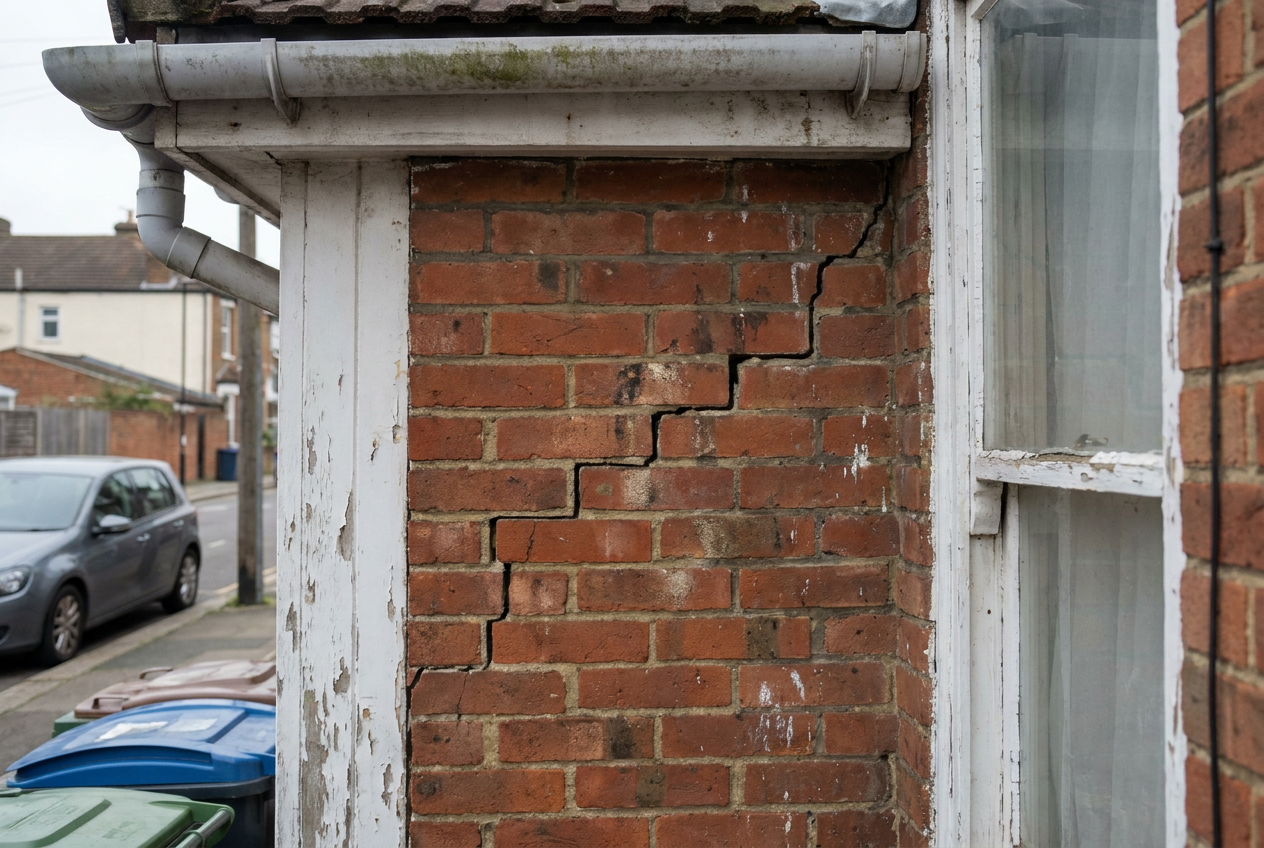
Diagonal cracks near windows
A crack wider at the top than the bottom, running through mortar or brick, often follows clay movement beneath that wall.
- 2
Doors catching on frames
Seasonal sticking can be normal timber swelling, but if a door jams worse each summer, the frame may be distorting.
- 3
Gaps opening at skirting boards
A visible space between the skirting and the floor suggests the wall has dropped relative to the floor slab.
- 4
Cracks reopening after filling
Decorative filler that splits again within months indicates the movement behind it has not stopped.
Questions about clay and subsidence in Barnet
Homeowners often ask whether the ground type guarantees problems. Here are the answers that come up most frequently.
- Does all of Barnet have clay?
- London Clay covers most of the borough, but patches of sand and gravel exist, especially on higher ground near Mill Hill and Totteridge.
- Will removing a tree fix it?
- Sometimes. But removing a large tree suddenly can cause the clay to swell rapidly, causing upward heave instead.
- How deep do foundations go?
- Older homes often have shallow footings. Modern ones on clay typically extend deeper to reach stable moisture levels.
- Is resin injection suitable for clay?
- It depends on the depth of movement and the soil profile. A specialist assesses whether resin or traditional methods fit the case.
- Can I monitor cracks myself?
- You can mark their ends with a pencil and date it, but telltale gauges fitted by a professional give measurable readings over time.
Ask about the ground beneath your home
Send details of what you have noticed. A specialist firm reviews the information and advises whether a site visit is needed. There is no obligation to proceed with any work.
- No obligation to proceed
- Reviewed by a specialist firm
- Advice based on your description